
On This Page
Marketing automation transforms Shopify stores from reactive businesses that manually manage every campaign into proactive operations that nurture customers around the clock. The right automations run in the background, sending the right message to the right person at the right time, driving revenue while you focus on growing your business.
This complete guide covers every essential automation for Shopify stores, the tools that power them, and step-by-step setup instructions to get your automated marketing engine running.
Why Shopify Stores Need Marketing Automation
The numbers make the case clearly:
| Metric | Manual Marketing | Automated Marketing |
|---|---|---|
| Revenue per email | $0.10-0.30 | $0.50-2.00 |
| Time spent per week | 15-25 hours | 3-5 hours (setup, then monitoring) |
| Cart recovery rate | 0-3% | 10-20% |
| Customer repeat rate | 15-25% | 30-45% |
| Welcome series conversion | N/A | 3-5x higher than standard campaigns |
For growing Shopify stores, automation is not about replacing human creativity. It is about ensuring consistent, personalized customer experiences at scale. See our marketing automation complete guide for foundational concepts.
The Essential Shopify Marketing Automations
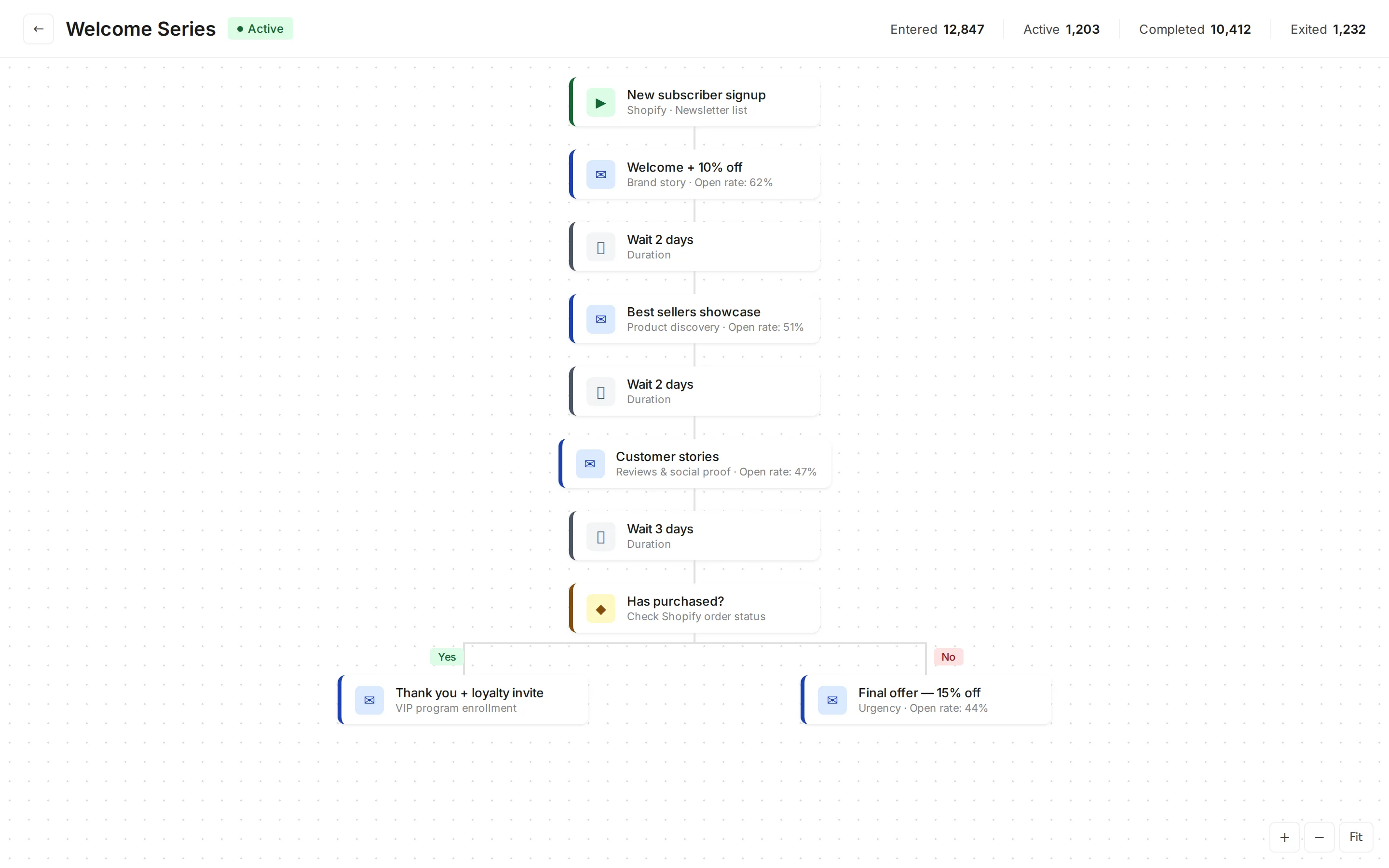
1. Welcome Series
Trigger: New customer or subscriber signup Goal: Introduce your brand and drive the first (or second) purchase
Recommended sequence:
| Timing | Content | Goal | |
|---|---|---|---|
| 1 | Immediate | Brand story, welcome offer | First impression |
| 2 | Day 2 | Best sellers, social proof | Product discovery |
| 3 | Day 4 | Customer stories, reviews | Trust building |
| 4 | Day 7 | Offer reminder (if no purchase) | Conversion push |
Expected results: Welcome series emails generate 4x higher open rates and 5x higher click rates than standard campaigns. Including a welcome discount (10-15% off) converts 15-25% of new subscribers.
For templates and strategies, see our welcome email series guide.
2. Abandoned Cart Recovery
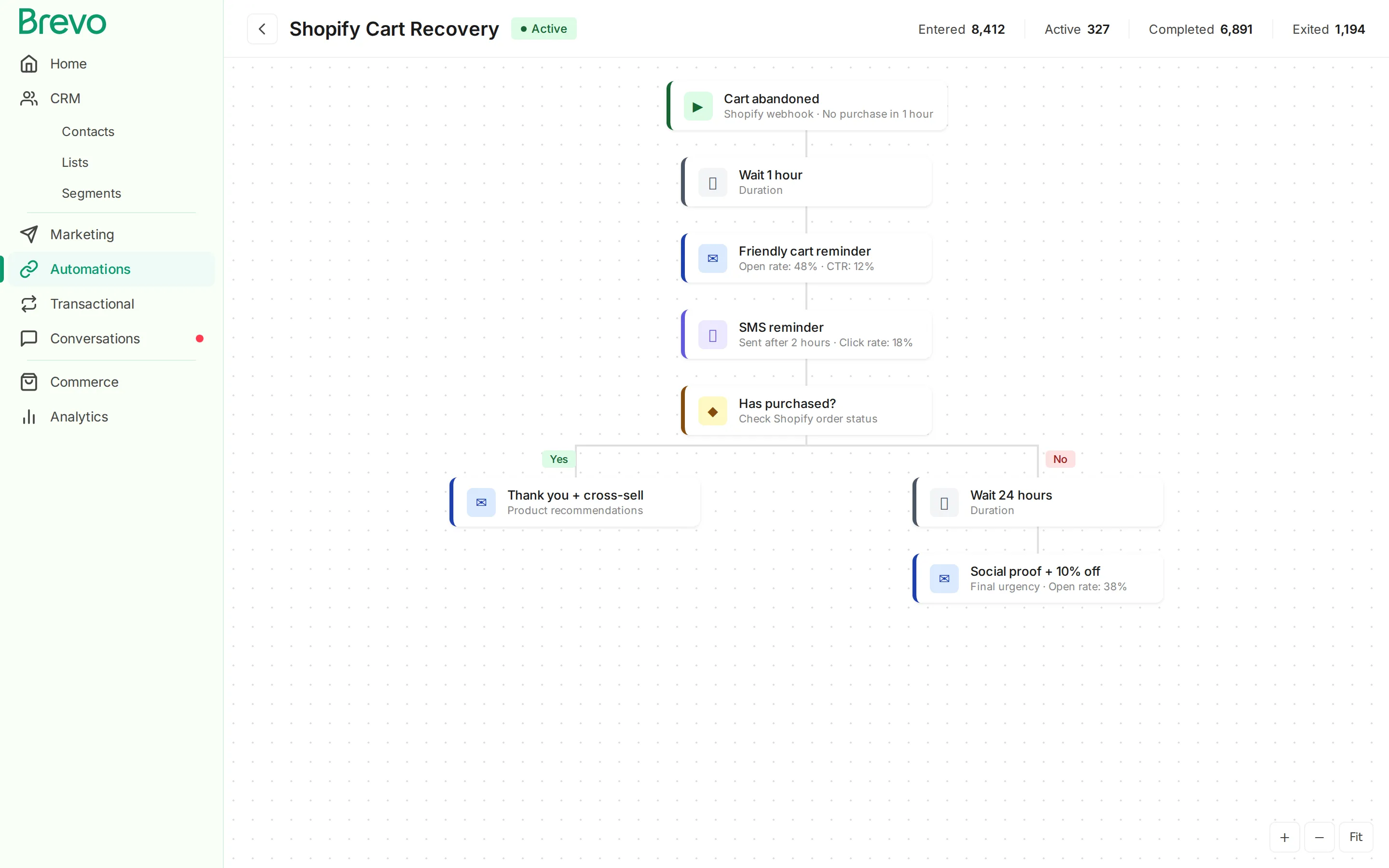
Trigger: Cart created but no purchase within 1 hour Goal: Recover lost sales
This is typically the highest-ROI automation for any Shopify store. A three-email sequence with optional SMS follow-ups recovers 10-20% of abandoned carts.
Recommended sequence:
| Step | Timing | Channel | Content |
|---|---|---|---|
| 1 | 1 hour | Friendly reminder, cart contents | |
| 2 | 2 hours | SMS | Brief reminder with link |
| 3 | 24 hours | Social proof, small incentive | |
| 4 | 48 hours | Final urgency, stronger incentive |
For detailed setup instructions, see our Shopify abandoned cart email guide.
3. Post-Purchase Follow-Up
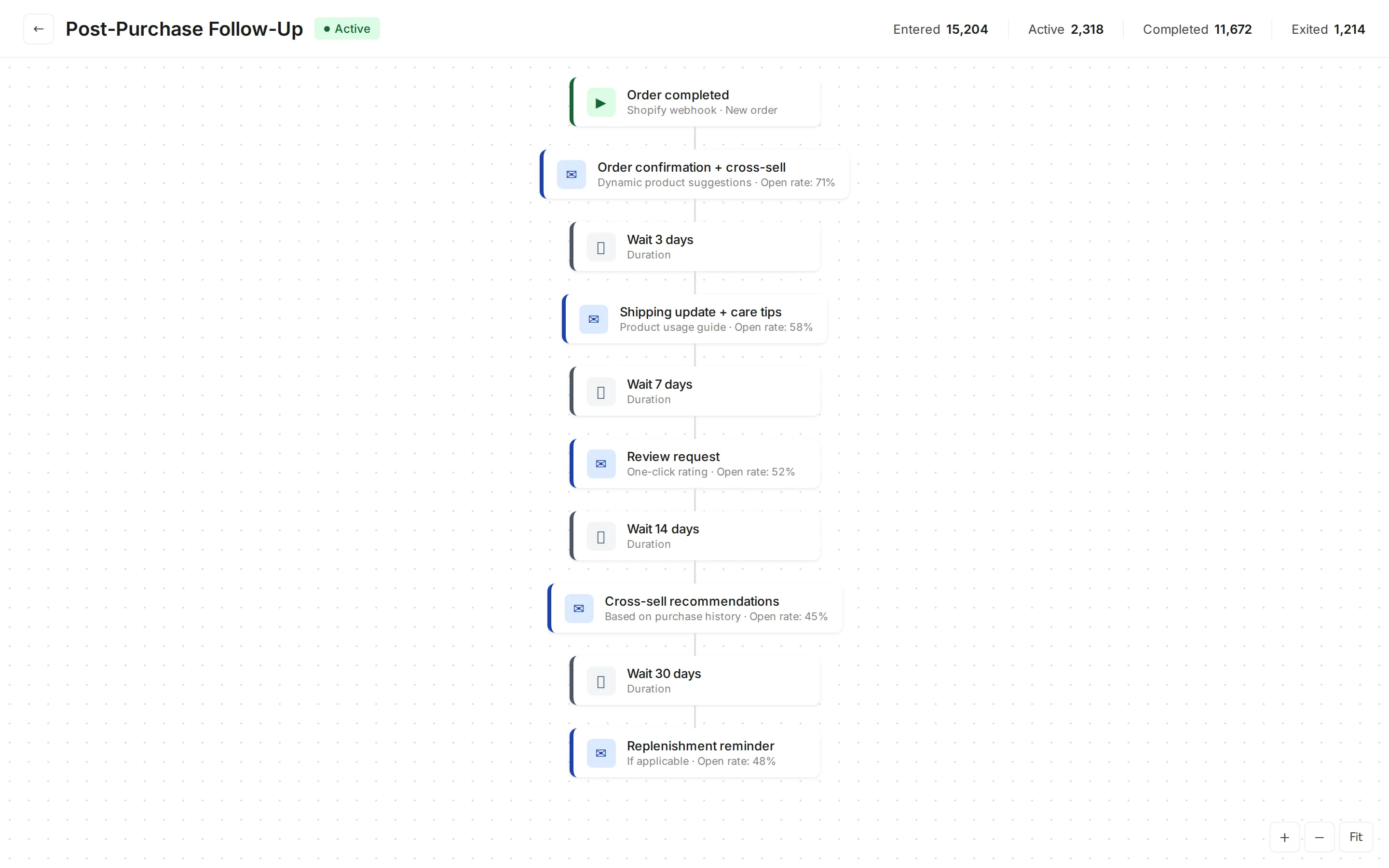
Trigger: Order completed Goal: Drive reviews, cross-sells, and repeat purchases
| Timing | Content | |
|---|---|---|
| 1 | Immediate | Order confirmation with cross-sell suggestions |
| 2 | Day 3 | Shipping update with product care tips |
| 3 | Day 7-10 | Review request |
| 4 | Day 14 | Cross-sell recommendations |
| 5 | Day 30 | Replenishment reminder (if applicable) |
For more on post-purchase strategy, see our post-purchase email guide.
4. Browse Abandonment
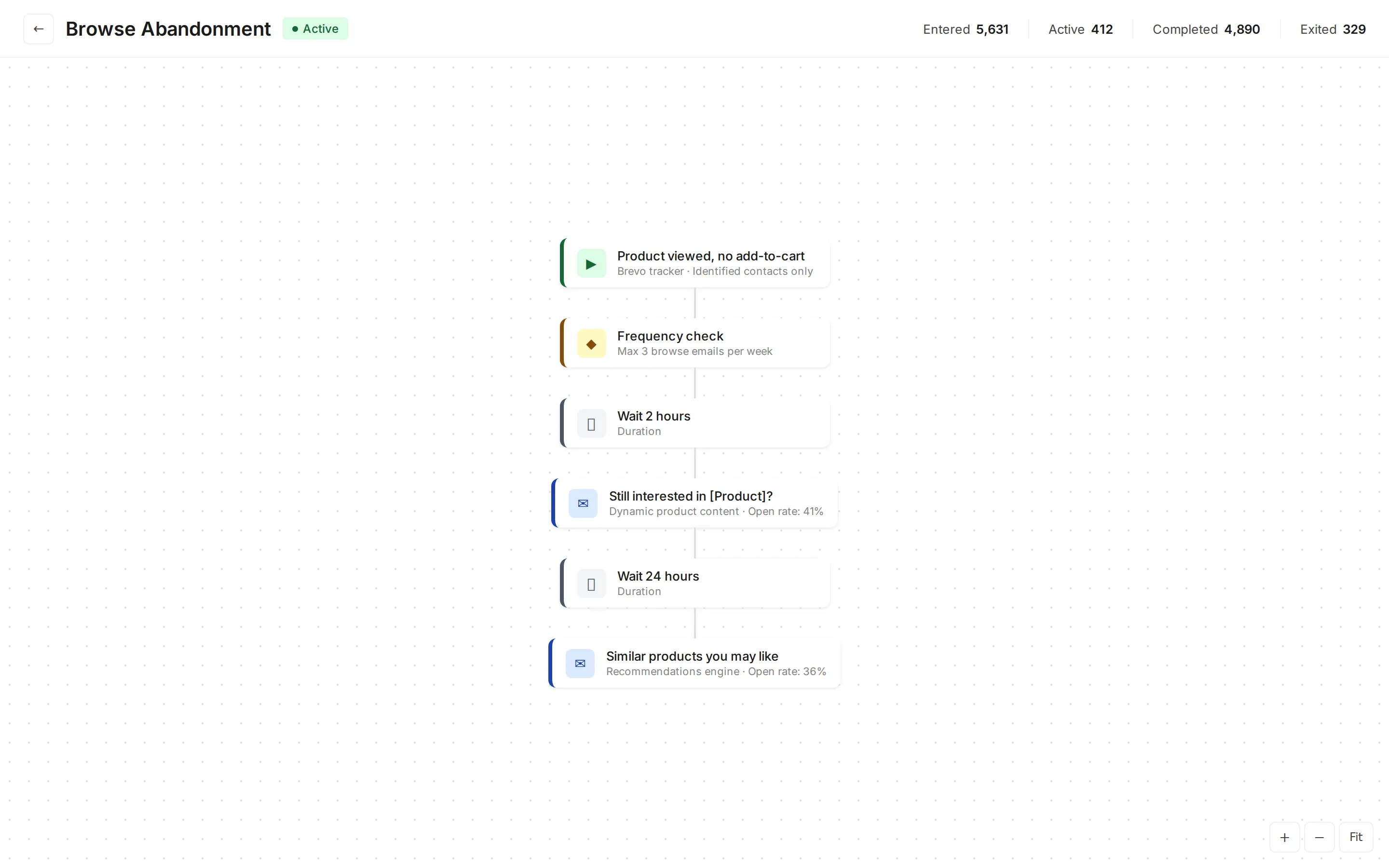
Trigger: Customer views products but does not add to cart Goal: Re-engage interested shoppers
| Timing | Content | |
|---|---|---|
| 1 | 2 hours | ”Still interested in [Product]?” with product details |
| 2 | 24 hours | Similar product recommendations |
Best practice: Only trigger this for identified contacts (logged-in users or known email subscribers). Send a maximum of 2-3 browse abandonment emails per week to avoid fatigue.
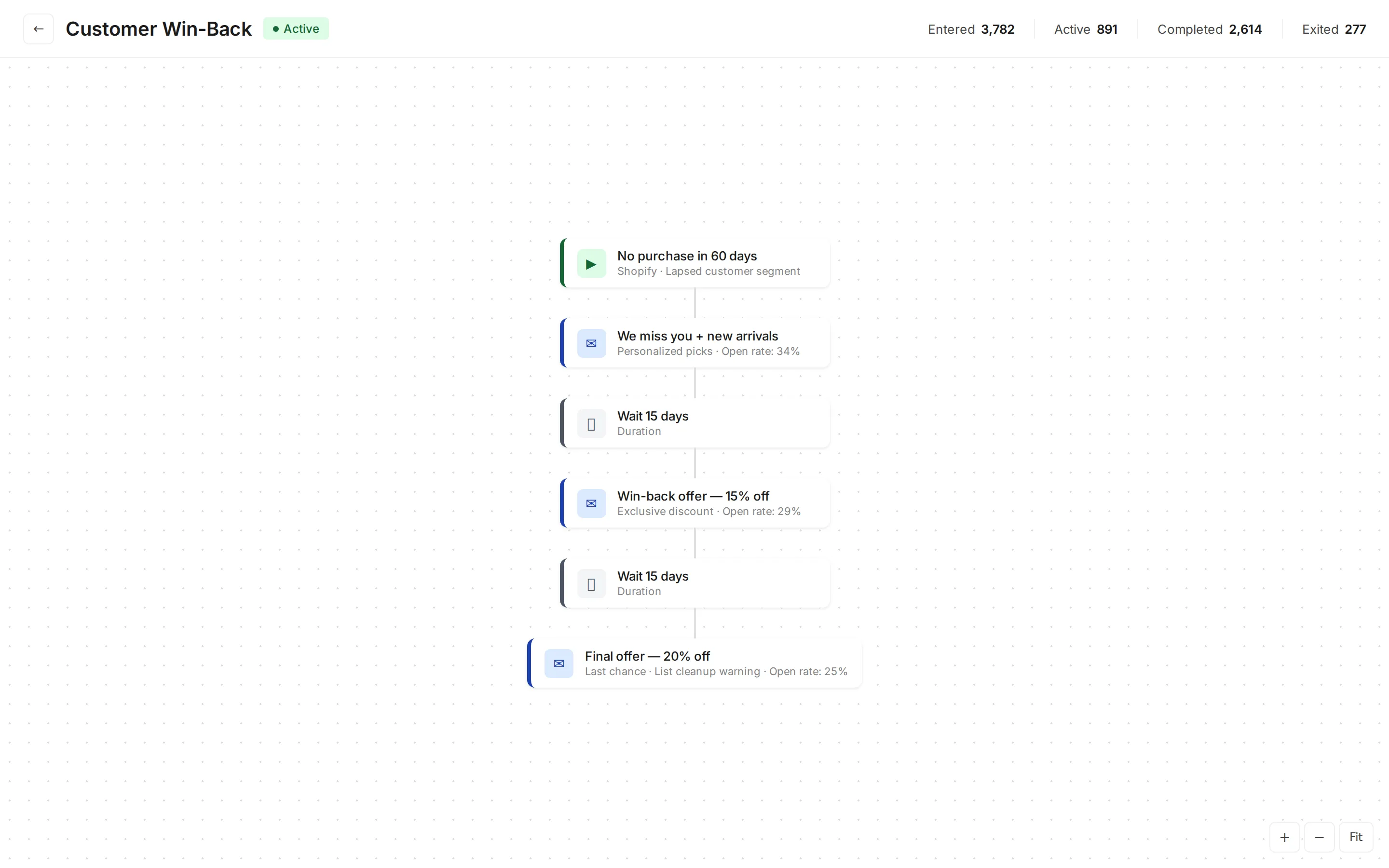
5. Customer Win-Back
Trigger: No purchase in 60-90 days Goal: Re-engage lapsed customers
| Timing | Content | |
|---|---|---|
| 1 | Day 60 | ”We miss you” with new arrivals |
| 2 | Day 75 | Win-back offer (15-20% off) |
| 3 | Day 90 | Final offer, mention of list cleanup |
Expected results: Win-back campaigns recover 3-8% of lapsed customers. The cost of re-activating an existing customer is 5-7x lower than acquiring a new one.
For re-engagement strategies, see our re-engagement email guide.
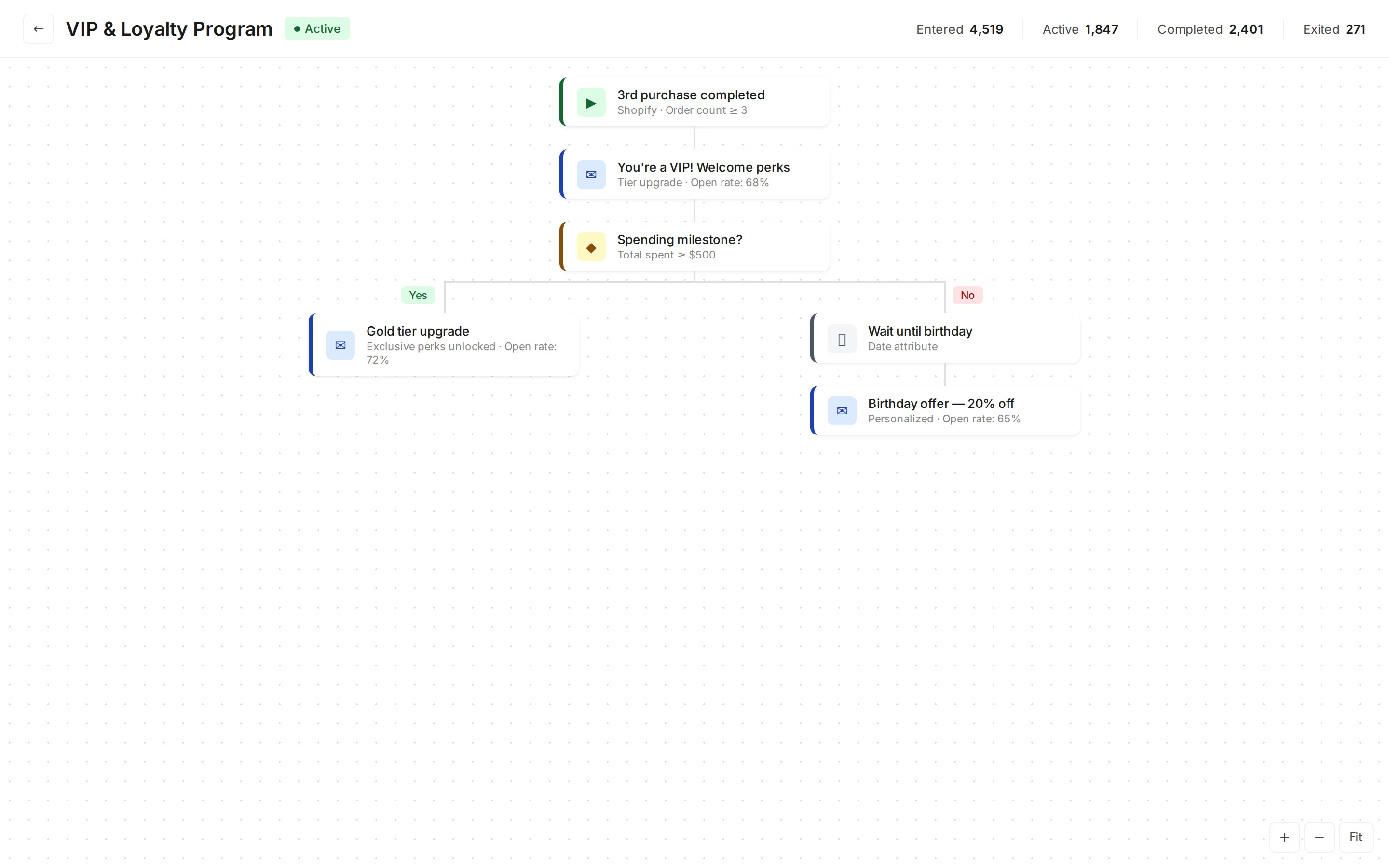
6. VIP and Loyalty Programs
Trigger: Customer reaches spending threshold or purchase milestone Goal: Reward and retain best customers
| Trigger | Action |
|---|---|
| 3rd purchase | ”You’re a VIP” welcome with perks |
| Spending milestone ($500) | Tier upgrade notification |
| Birthday | Personalized birthday offer |
| Anniversary | First purchase anniversary reward |
For loyalty program strategies, see our customer loyalty program guide.
7. Product Replenishment
Trigger: Estimated time since last purchase of a consumable product Goal: Drive repeat purchases at the right moment
| Product Type | Replenishment Timing | Message |
|---|---|---|
| Skincare (30-day supply) | Day 25 | ”Time to restock your [Product]?” |
| Coffee (2-week supply) | Day 12 | ”Running low on [Blend]?” |
| Pet food (monthly) | Day 28 | ”[Pet name] is almost out of [Product]“ |
| Supplements (60-day) | Day 50 | ”Reorder your [Product] with 10% off” |
8. Review and UGC Collection
Trigger: Delivery confirmed + delay period Goal: Collect reviews, photos, and user-generated content
Best practice: Send 5-7 days after delivery for physical products. Make the review process as simple as possible with a one-click rating in the email that leads to a full review form.
Automation Performance Benchmarks
| Automation | Open Rate | CTR | Conversion Rate | Revenue Impact |
|---|---|---|---|---|
| Welcome series | 50-70% | 10-15% | 15-25% | Foundation |
| Cart recovery | 40-55% | 8-15% | 5-15% | Highest direct ROI |
| Post-purchase | 55-65% | 8-12% | 3-8% | Long-term CLV |
| Browse abandonment | 35-50% | 5-10% | 2-5% | Incremental |
| Win-back | 25-40% | 3-8% | 3-8% | Re-activation |
| VIP/loyalty | 55-70% | 12-18% | 10-20% | Retention |
| Replenishment | 45-60% | 10-15% | 8-15% | Repeat revenue |
Common Mistakes to Avoid
1. Launching everything at once. Start with 2-3 automations, optimize them, then expand. Launching ten workflows simultaneously makes it impossible to troubleshoot issues.
2. Not suppressing across automations. A customer should not receive a cart recovery email, a browse abandonment email, and a promotional campaign on the same day. Set frequency caps and suppression rules.
3. Using generic content. Dynamic product content powered by your synced catalog data always outperforms generic messaging. Invest the time to set up dynamic blocks.
4. Ignoring SMS. Email-only recovery leaves significant revenue on the table. Adding SMS to cart recovery alone can increase recovery rates by 30-50%.
5. Setting and forgetting. Review automation performance monthly. Update creative quarterly. Customer behavior and market conditions change, and your automations should evolve with them.
Getting Started
Shopify marketing automation is not a project with a finish line. It is an ongoing system that grows more valuable as you add automations, refine triggers, and learn what resonates with your customers.
Every automation you add compounds the value, creating a marketing engine that drives revenue around the clock.
For related strategies, explore our email marketing automation workflows guide, Shopify CRM guide, and marketing automation examples.
Where Tajo fits
Tajo is the agentic integration builder. Keep your providers. Agents connect everything else, and you approve each sync. Tajo is in early access. Request early access
Frequently Asked Questions
What are the most important Shopify marketing automations?
The highest-ROI automations are: welcome series (5x higher engagement), abandoned cart recovery (recovers 10-20% of lost sales), post-purchase follow-ups (drives reviews and repeat purchases), and win-back campaigns (re-engages lapsed customers).